


How to Build Supervised AI Models When You Don’t Have Annotated Data

One of the biggest challenges in real-world machine learning is that supervised models require labeled data—yet in many practical scenarios, the data you start with is almost always unlabeled. Manually annotating thousands of samples isn’t just slow; it’s expensive, tedious, and often impractical. This is where active learning becomes a game-changer. Active learning is a…

Read More

How to Design a Persistent Memory and Personalized Agentic AI System with Decay and Self-Evaluation?

In this tutorial, we explore how to build an intelligent agent that remembers, learns, and adapts to us over time. We implement a Persistent Memory & Personalisation system using simple, rule-based logic to simulate how modern Agentic AI frameworks store and recall contextual information. As we progress, we see how the agent’s responses evolve with…

Read More

How to Create AI-ready APIs?

Postman recently released a comprehensive checklist and developer guide for building AI-ready APIs, highlighting a simple truth: even the most powerful AI models are only as good as the data they receive—and that data comes through your APIs. If your endpoints are inconsistent, unclear, or unreliable, models waste time fixing bad inputs instead of producing…

Read More

LongCat-Flash-Omni: A SOTA Open-Source Omni-Modal Model with 560B Parameters with 27B activated, Excelling at Real-Time Audio-Visual Interaction

How do you design a single model that can listen, see, read and respond in real time across text, image, video and audio without losing the efficiency? Meituan’s LongCat team has released LongCat Flash Omni, an open source omni modal model with 560 billion parameters and about 27 billion active per token, built on the…

Read More

A Coding Implementation of a Comprehensive Enterprise AI Benchmarking Framework to Evaluate Rule-Based LLM, and Hybrid Agentic AI Systems Across Real-World Tasks

In this tutorial, we develop a comprehensive benchmarking framework to evaluate various types of agentic AI systems on real-world enterprise software tasks. We design a suite of diverse challenges, from data transformation and API integration to workflow automation and performance optimization, and assess how various agents, including rule-based, LLM-powered, and hybrid ones, perform across these…

Read More

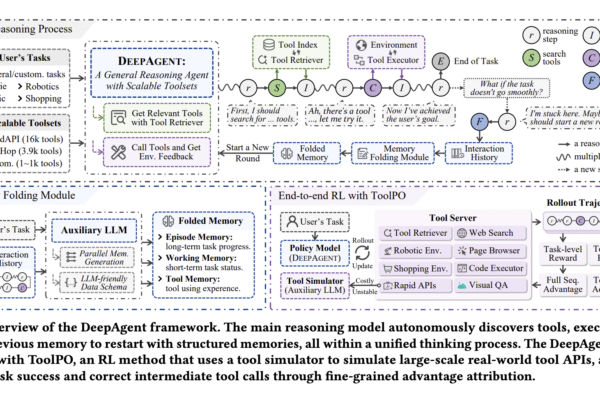
DeepAgent: A Deep Reasoning AI Agent that Performs Autonomous Thinking, Tool Discovery, and Action Execution within a Single Reasoning Process

Most agent frameworks still run a predefined Reason, Act, Observe loop, so the agent can only use the tools that are injected in the prompt. This works for small tasks, but it fails when the toolset is large, when the task is long, and when the agent must change strategy in the middle of reasoning….

Read More

Anthropic’s New Research Shows Claude can Detect Injected Concepts, but only in Controlled Layers

How do you tell whether a model is actually noticing its own internal state instead of just repeating what training data said about thinking? In a latest Anthropic’s research study ‘Emergent Introspective Awareness in Large Language Models‘ asks whether current Claude models can do more than talk about their abilities, it asks whether they can…

Read More

How to Build an End-to-End Data Engineering and Machine Learning Pipeline with Apache Spark and PySpark

!pip install -q pyspark==3.5.1 from pyspark.sql import SparkSession, functions as F, Window from pyspark.sql.types import IntegerType, StringType, StructType, StructField, FloatType from pyspark.ml.feature import StringIndexer, VectorAssembler from pyspark.ml.classification import LogisticRegression from pyspark.ml.evaluation import MulticlassClassificationEvaluator spark = (SparkSession.builder.appName(“ColabSparkAdvancedTutorial”) .master(“local[*]”) .config(“spark.sql.shuffle.partitions”, “4”) .getOrCreate()) print(“Spark version:”, spark.version) data = [ (1, “Alice”, “IN”, “2025-10-01”, 56000.0, “premium”), (2, “Bob”, “US”,…

Read More

Google AI Unveils Supervised Reinforcement Learning (SRL): A Step Wise Framework with Expert Trajectories to Teach Small Language Models to Reason through Hard Problems

How can a small model learn to solve tasks it currently fails at, without rote imitation or relying on a correct rollout? A team of researchers from Google Cloud AI Research and UCLA have released a training framework, ‘Supervised Reinforcement Learning’ (SRL), that makes 7B scale models actually learn from very hard math and agent…

Read More