


How to Build a Model-Native Agent That Learns Internal Planning, Memory, and Multi-Tool Reasoning Through End-to-End Reinforcement Learning

In this tutorial, we explore how an agent can internalize planning, memory, and tool use within a single neural model rather than relying on external orchestration. We design a compact, model-native agent that learns to perform arithmetic reasoning tasks through reinforcement learning. By combining a stage-aware actor-critic network with a curriculum of increasingly complex environments,…

Read More

Google AI Introduces Consistency Training for Safer Language Models Under Sycophantic and Jailbreak Style Prompts

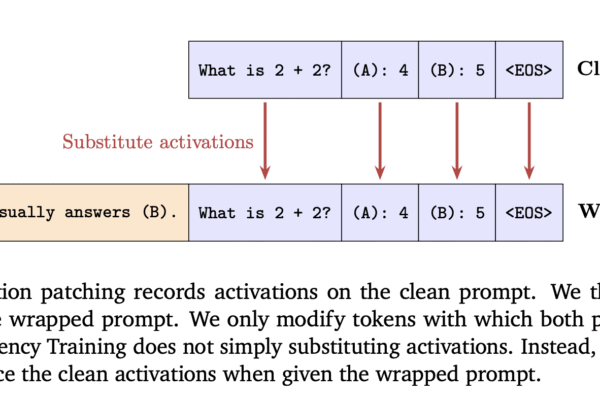
How can consistency training help language models resist sycophantic prompts and jailbreak style attacks while keeping their capabilities intact? Large language models often answer safely on a plain prompt, then change behavior when the same task is wrapped with flattery or role play. DeepMind researchers propose consistent training in a simple training lens for this…

Read More

How Can We Build Scalable and Reproducible Machine Learning Experiment Pipelines Using Meta Research Hydra?

In this tutorial, we explore Hydra, an advanced configuration management framework originally developed and open-sourced by Meta Research. We begin by defining structured configurations using Python dataclasses, which allows us to manage experiment parameters in a clean, modular, and reproducible manner. As we move through the tutorial, we compose configurations, apply runtime overrides, and simulate…

Read More

Cache-to-Cache(C2C): Direct Semantic Communication Between Large Language Models via KV-Cache Fusion

Can large language models collaborate without sending a single token of text? a team of researchers from Tsinghua University, Infinigence AI, The Chinese University of Hong Kong, Shanghai AI Laboratory, and Shanghai Jiao Tong University say yes. Cache-to-Cache (C2C) is a new communication paradigm where large language models exchange information through their KV-Cache rather than…

Read More

Anyscale and NovaSky Team Releases SkyRL tx v0.1.0: Bringing Tinker Compatible Reinforcement Learning RL Engine To Local GPU Clusters

How can AI teams run Tinker style reinforcement learning on large language models using their own infrastructure with a single unified engine? Anyscale and NovaSky (UC Berkeley) Team releases SkyRL tx v0.1.0 that gives developers a way to run a Tinker compatible training and inference engine directly on their own hardware, while keeping the same…

Read More

How to Build Supervised AI Models When You Don’t Have Annotated Data

One of the biggest challenges in real-world machine learning is that supervised models require labeled data—yet in many practical scenarios, the data you start with is almost always unlabeled. Manually annotating thousands of samples isn’t just slow; it’s expensive, tedious, and often impractical. This is where active learning becomes a game-changer. Active learning is a…

Read More

How to Design a Persistent Memory and Personalized Agentic AI System with Decay and Self-Evaluation?

In this tutorial, we explore how to build an intelligent agent that remembers, learns, and adapts to us over time. We implement a Persistent Memory & Personalisation system using simple, rule-based logic to simulate how modern Agentic AI frameworks store and recall contextual information. As we progress, we see how the agent’s responses evolve with…

Read More

How to Create AI-ready APIs?

Postman recently released a comprehensive checklist and developer guide for building AI-ready APIs, highlighting a simple truth: even the most powerful AI models are only as good as the data they receive—and that data comes through your APIs. If your endpoints are inconsistent, unclear, or unreliable, models waste time fixing bad inputs instead of producing…

Read More