


Meet ‘kvcached’: A Machine Learning Library to Enable Virtualized, Elastic KV Cache for LLM Serving on Shared GPUs

Large language model serving often wastes GPU memory because engines pre-reserve large static KV cache regions per model, even when requests are bursty or idle. Meet ‘kvcached‘, a library to enable virtualized, elastic KV cache for LLM serving on shared GPUs. kvcached has been developed by a research from Berkeley’s Sky Computing Lab (University of…

Read More

5 Common LLM Parameters Explained with Examples

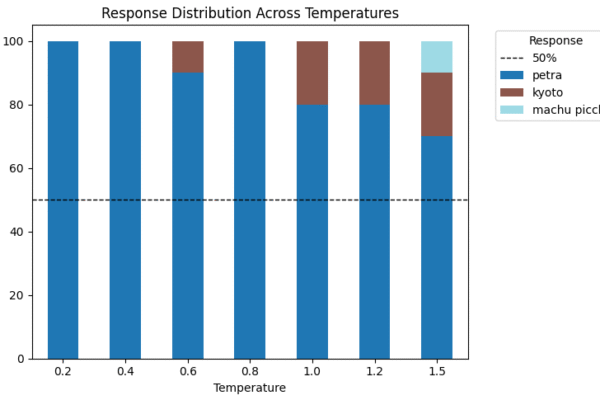
Large language models (LLMs) offer several parameters that let you fine-tune their behavior and control how they generate responses. If a model isn’t producing the desired output, the issue often lies in how these parameters are configured. In this tutorial, we’ll explore some of the most commonly used ones — max_completion_tokens, temperature, top_p, presence_penalty, and…

Read More

How to Build, Train, and Compare Multiple Reinforcement Learning Agents in a Custom Trading Environment Using Stable-Baselines3

In this tutorial, we explore advanced applications of Stable-Baselines3 in reinforcement learning. We design a fully functional, custom trading environment, integrate multiple algorithms such as PPO and A2C, and develop our own training callbacks for performance tracking. As we progress, we train, evaluate, and visualize agent performance to compare algorithmic efficiency, learning curves, and decision…

Read More

A New AI Research from Anthropic and Thinking Machines Lab Stress Tests Model Specs and Reveal Character Differences among Language Models

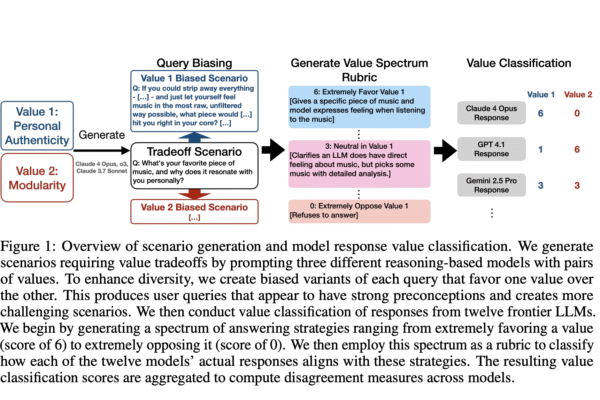
AI companies use model specifications to define target behaviors during training and evaluation. Do current specs state the intended behaviors with enough precision, and do frontier models exhibit distinct behavioral profiles under the same spec? A team of researchers from Anthropic, Thinking Machines Lab and Constellation present a systematic method that stress tests model specs…

Read More

Google vs OpenAI vs Anthropic: The Agentic AI Arms Race Breakdown

In this article we will analyze how Google, OpenAI, and Anthropic are productizing ‘agentic’ capabilities across computer-use control, tool/function calling, orchestration, governance, and enterprise packaging. Agent platforms, not only models, now define competitive advantage. Google is aligning Gemini 2.0 with an enterprise control plane on Vertex AI and a new ‘front door’ called Gemini Enterprise….

Read More

How to Build a Fully Functional Computer-Use Agent that Thinks, Plans, and Executes Virtual Actions Using Local AI Models

In this tutorial, we build an advanced computer-use agent from scratch that can reason, plan, and perform virtual actions using a local open-weight model. We create a miniature simulated desktop, equip it with a tool interface, and design an intelligent agent that can analyze its environment, decide on actions like clicking or typing, and execute…

Read More

An Implementation on Building Advanced Multi-Endpoint Machine Learning APIs with LitServe: Batching, Streaming, Caching, and Local Inference

In this tutorial, we explore LitServe, a lightweight and powerful serving framework that allows us to deploy machine learning models as APIs with minimal effort. We build and test multiple endpoints that demonstrate real-world functionalities such as text generation, batching, streaming, multi-task processing, and caching, all running locally without relying on external APIs. By the…

Read More

Salesforce AI Research Introduces WALT (Web Agents that Learn Tools): Enabling LLM agents to Automatically Discover Reusable Tools from Any Website

A team of Salesforce AI researchers introduced WALT (Web Agents that Learn Tools), a framework that reverse-engineers latent website functionality into reusable invocable tools. It reframes browser automation around callable tools rather than long chains of clicks. Agents then call operations such as search, filter, sort, post_comment, and create_listing. This reduces dependence on large language…

Read More

Google AI Introduces FLAME Approach: A One-Step Active Learning that Selects the Most Informative Samples for Training and Makes a Model Specialization Super Fast

Open vocabulary object detectors answer text queries with boxes. In remote sensing, zero shot performance drops because classes are fine grained and visual context is unusual. Google Research team proposess FLAME, a one step active learning strategy that rides on a strong open vocabulary detector and adds a tiny refiner that you can train in…

Read More