



Meet LangChain’s DeepAgents Library and a Practical Example to See How DeepAgents Actually Work in Action

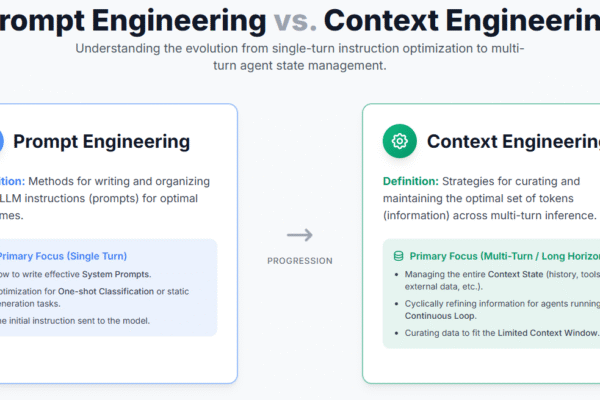
While a basic Large Language Model (LLM) agent—one that repeatedly calls external tools—is easy to create, these agents often struggle with long and complex tasks because they lack the ability to plan ahead and manage their work over time. They can be considered “shallow” in their execution. The deepagents library is designed to overcome this…

Read More

An Implementation to Build Dynamic AI Systems with the Model Context Protocol (MCP) for Real-Time Resource and Tool Integration

In this tutorial, we explore the Advanced Model Context Protocol (MCP) and demonstrate how to use it to address one of the most unique challenges in modern AI systems: enabling real-time interaction between AI models and external data or tools. Traditional models operate in isolation, limited to their training data, but through MCP, we create…

Read More

Weak-for-Strong (W4S): A Novel Reinforcement Learning Algorithm that Trains a weak Meta Agent to Design Agentic Workflows with Stronger LLMs

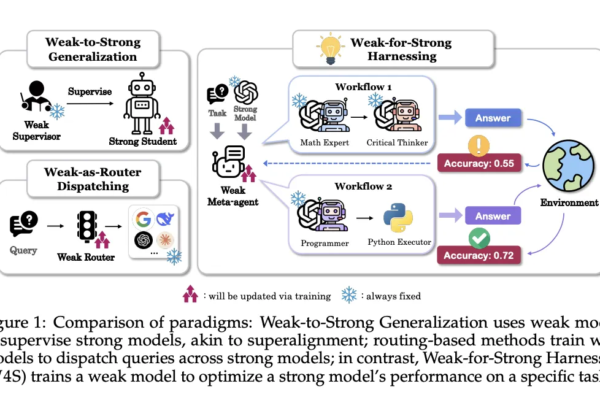
Researchers from Stanford, EPFL, and UNC introduce Weak-for-Strong Harnessing, W4S, a new Reinforcement Learning RL framework that trains a small meta-agent to design and refine code workflows that call a stronger executor model. The meta-agent does not fine tune the strong model, it learns to orchestrate it. W4S formalizes workflow design as a multi turn…

Read More

Microsoft AI Proposes BitNet Distillation (BitDistill): A Lightweight Pipeline that Delivers up to 10x Memory Savings and about 2.65x CPU Speedup

Microsoft Research proposes BitNet Distillation, a pipeline that converts existing full precision LLMs into 1.58 bit BitNet students for specific tasks, while keeping accuracy close to the FP16 teacher and improving CPU efficiency. The method combines SubLN based architectural refinement, continued pre training, and dual signal distillation from logits and multi head attention relations. Reported…

Read More

Kong Releases Volcano: A TypeScript, MCP-native SDK for Building Production Ready AI Agents with LLM Reasoning and Real-World actions

Kong has open-sourced Volcano, a TypeScript SDK that composes multi-step agent workflows across multiple LLM providers with native Model Context Protocol (MCP) tool use. The release coincides with broader MCP capabilities in Kong AI Gateway and Konnect, positioning Volcano as the developer SDK in an MCP-governed control plane. Why Volcano SDK? because 9 lines of code…

Read More

AutoCode: A New AI Framework that Lets LLMs Create and Verify Competitive Programming Problems, Mirroring the Workflow of Human Problem Setters

Are your LLM code benchmarks actually rejecting wrong-complexity solutions and interactive-protocol violations, or are they passing under-specified unit tests? A team of researchers from UCSD, NYU, University of Washington, Princeton University, Canyon Crest Academy, OpenAI, UC Berkeley, MIT, University of Waterloo, and Sentient Labs introduce AutoCode, a new AI framework that lets LLMs create and…

Read More

Sigmoidal Scaling Curves Make Reinforcement Learning RL Post-Training Predictable for LLMs

Reinforcement Learning RL post-training is now a major lever for reasoning-centric LLMs, but unlike pre-training, it hasn’t had predictive scaling rules. Teams pour tens of thousands of GPU-hours into runs without a principled way to estimate whether a recipe will keep improving with more compute. A new research from Meta, UT Austin, UCL, Berkeley, Harvard,…

Read More

A Coding Implementation to Build a Unified Tool Orchestration Framework from Documentation to Automated Pipelines

In this tutorial, we build a compact, efficient framework that demonstrates how to convert tool documentation into standardized, callable interfaces, register those tools in a central system, and execute them as part of an automated pipeline. As we move through each stage, we create a simple converter, design mock bioinformatics tools, organize them into a…

Read More