


A Coding Guide to Build an AI-Powered Cryptographic Agent System with Hybrid Encryption, Digital Signatures, and Adaptive Security Intelligence

In this tutorial, we build an AI-powered cryptographic agent system that combines the strength of classical encryption with adaptive intelligence. We design agents capable of performing hybrid encryption with RSA and AES, generating digital signatures, detecting anomalies in message patterns, and intelligently recommending key rotations. As we progress, we witness these autonomous agents securely establish…

Read More

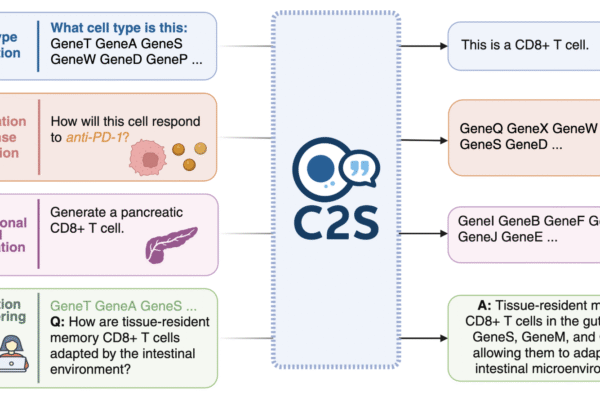
Google AI Releases C2S-Scale 27B Model that Translate Complex Single-Cell Gene Expression Data into ‘cell sentences’ that LLMs can Understand

A team of researchers from Google Research, Google DeepMind, and Yale released C2S-Scale 27B, a 27-billion-parameter foundation model for single-cell analysis built on Gemma-2. The model formalizes single-cell RNA-seq (scRNA-seq) profiles as “cell sentences”—ordered lists of gene symbols—so that a language model can natively parse and reason over cellular states. Beyond benchmarking gains, the research…

Read More

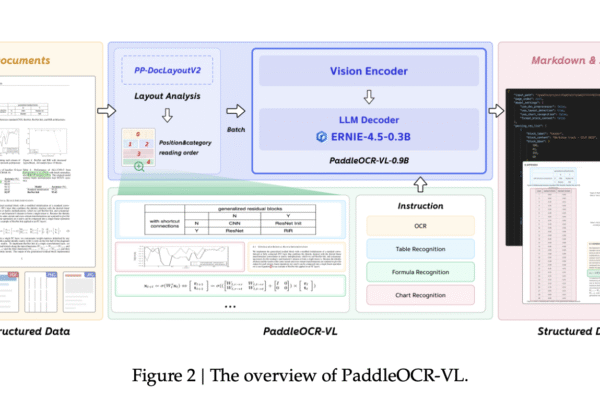
Baidu’s PaddlePaddle Team Releases PaddleOCR-VL (0.9B): a NaViT-style + ERNIE-4.5-0.3B VLM Targeting End-to-End Multilingual Document Parsing

How do you convert complex, multilingual documents—dense layouts, small scripts, formulas, charts, and handwriting—into faithful structured Markdown/JSON with state-of-the-art accuracy while keeping inference latency and memory low enough for real deployments?Baidu’s PaddlePaddle group has released PaddleOCR-VL, a 0.9B-parameter vision-language model designed for end-to-end document parsing across text, tables, formulas, charts, and handwriting. The core model…

Read More

Qualifire AI Releases Rogue: An End-to-End Agentic AI Testing Framework, Evaluating the Performance of AI Agents

Agentic systems are stochastic, context-dependent, and policy-bounded. Conventional QA—unit tests, static prompts, or scalar “LLM-as-a-judge” scores—fails to expose multi-turn vulnerabilities and provides weak audit trails. Developer teams need protocol-accurate conversations, explicit policy checks, and machine-readable evidence that can gate releases with confidence. Qualifire AI has open-sourced Rogue, a Python framework that evaluates AI agents over…

Read More

Qualifire AI Open-Sources Rogue: An End-to-End Agentic AI Testing Framework Designed to Evaluate the Performance, Compliance, and Reliability of AI Agents

Agentic systems are stochastic, context-dependent, and policy-bounded. Conventional QA—unit tests, static prompts, or scalar “LLM-as-a-judge” scores—fails to expose multi-turn vulnerabilities and provides weak audit trails. Developer teams need protocol-accurate conversations, explicit policy checks, and machine-readable evidence that can gate releases with confidence. Qualifire AI has open-sourced Rogue, a Python framework that evaluates AI agents over…

Read More

Building a Context-Folding LLM Agent for Long-Horizon Reasoning with Memory Compression and Tool Use

In this tutorial, we explore how to build a Context-Folding LLM Agent that efficiently solves long, complex tasks by intelligently managing limited context. We design the agent to break down a large task into smaller subtasks, perform reasoning or calculations when needed, and then fold each completed sub-trajectory into concise summaries. By doing this, we…

Read More

QeRL: NVFP4-Quantized Reinforcement Learning (RL) Brings 32B LLM Training to a Single H100—While Improving Exploration

What would you build if you could run Reinforcement Learning (RL) post-training on a 32B LLM in 4-bit NVFP4—on a single H100—with BF16-level accuracy and 1.2–1.5× step speedups? NVIDIA researchers (with collaborators from MIT, HKU, and Tsinghua) have open-sourced QeRL (Quantization-enhanced Reinforcement Learning), a training framework that pushes Reinforcement Learning (RL) post-training into 4-bit FP4…

Read More

Ivy Framework Agnostic Machine Learning Build, Transpile, and Benchmark Across All Major Backends

In this tutorial, we explore Ivy’s remarkable ability to unify machine learning development across frameworks. We begin by writing a fully framework-agnostic neural network that runs seamlessly on NumPy, PyTorch, TensorFlow, and JAX. We then dive into code transpilation, unified APIs, and advanced features like Ivy Containers and graph tracing, all designed to make deep…

Read More

Anthropic Launches Claude Haiku 4.5: Small AI Model that Delivers Sonnet-4-Level Coding Performance at One-Third the Cost and more than Twice the Speed

Anthropic released Claude Haiku 4.5, a latency-optimized “small” model that delivers similar levels of coding performance to Claude Sonnet 4 while running more than twice as fast at one-third the cost. The model is immediately available via Anthropic’s API and in partner catalogs on Amazon Bedrock and Google Cloud Vertex AI. Pricing is $1/MTok input…

Read More

ServiceNow AI Research Releases DRBench, a Realistic Enterprise Deep-Research Benchmark

ServiceNow Research has released DRBench, a benchmark and runnable environment to evaluate “deep research” agents on open-ended enterprise tasks that require synthesizing facts from both public web and private organizational data into properly cited reports. Unlike web-only testbeds, DRBench stages heterogeneous, enterprise-style workflows—files, emails, chat logs, and cloud storage—so agents must retrieve, filter, and attribute…

Read More