



Ivy Framework Agnostic Machine Learning Build, Transpile, and Benchmark Across All Major Backends

In this tutorial, we explore Ivy’s remarkable ability to unify machine learning development across frameworks. We begin by writing a fully framework-agnostic neural network that runs seamlessly on NumPy, PyTorch, TensorFlow, and JAX. We then dive into code transpilation, unified APIs, and advanced features like Ivy Containers and graph tracing, all designed to make deep…

Read More

Anthropic Launches Claude Haiku 4.5: Small AI Model that Delivers Sonnet-4-Level Coding Performance at One-Third the Cost and more than Twice the Speed

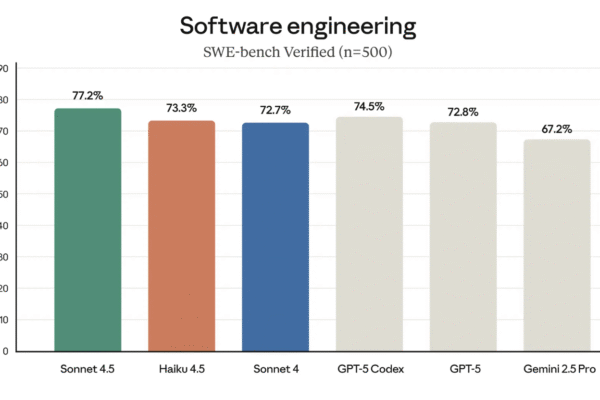
Anthropic released Claude Haiku 4.5, a latency-optimized “small” model that delivers similar levels of coding performance to Claude Sonnet 4 while running more than twice as fast at one-third the cost. The model is immediately available via Anthropic’s API and in partner catalogs on Amazon Bedrock and Google Cloud Vertex AI. Pricing is $1/MTok input…

Read More

ServiceNow AI Research Releases DRBench, a Realistic Enterprise Deep-Research Benchmark

ServiceNow Research has released DRBench, a benchmark and runnable environment to evaluate “deep research” agents on open-ended enterprise tasks that require synthesizing facts from both public web and private organizational data into properly cited reports. Unlike web-only testbeds, DRBench stages heterogeneous, enterprise-style workflows—files, emails, chat logs, and cloud storage—so agents must retrieve, filter, and attribute…

Read More

7 LLM Generation Parameters—What They Do and How to Tune Them?

Tuning LLM outputs is largely a decoding problem: you shape the model’s next-token distribution with a handful of sampling controls—max tokens (caps response length under the model’s context limit), temperature (logit scaling for more/less randomness), top-p/nucleus and top-k (truncate the candidate set by probability mass or rank), frequency and presence penalties (discourage repetition or encourage…

Read More

NVIDIA Researchers Propose Reinforcement Learning Pretraining (RLP): Reinforcement as a Pretraining Objective for Building Reasoning During Pretraining

NVIDIA AI has introduced Reinforcement Learning Pretraining (RLP), a training objective that injects reinforcement learning into the pretraining stage rather than deferring it to post-training. The core idea is simple and testable: treat a short chain-of-thought (CoT) as an action sampled before next-token prediction and reward it by the information gain it provides on the…

Read More

A Coding Implementation of Advanced PyTest to Build Customized and Automated Testing with Plugins, Fixtures, and JSON Reporting

In this tutorial, we explore the advanced capabilities of PyTest, one of the most powerful testing frameworks in Python. We build a complete mini-project from scratch that demonstrates fixtures, markers, plugins, parameterization, and custom configuration. We focus on showing how PyTest can evolve from a simple test runner into a robust, extensible system for real-world…

Read More