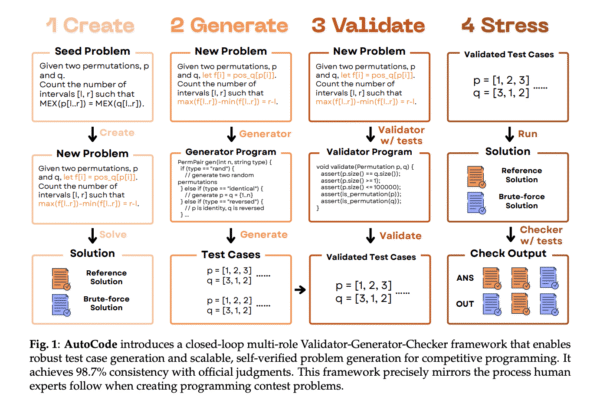




AutoCode: A New AI Framework that Lets LLMs Create and Verify Competitive Programming Problems, Mirroring the Workflow of Human Problem Setters

Are your LLM code benchmarks actually rejecting wrong-complexity solutions and interactive-protocol violations, or are they passing under-specified unit tests? A team of researchers from UCSD, NYU, University of Washington, Princeton University, Canyon Crest Academy, OpenAI, UC Berkeley, MIT, University of Waterloo, and Sentient Labs introduce AutoCode, a new AI framework that lets LLMs create and…

Read More

Sigmoidal Scaling Curves Make Reinforcement Learning RL Post-Training Predictable for LLMs

Reinforcement Learning RL post-training is now a major lever for reasoning-centric LLMs, but unlike pre-training, it hasn’t had predictive scaling rules. Teams pour tens of thousands of GPU-hours into runs without a principled way to estimate whether a recipe will keep improving with more compute. A new research from Meta, UT Austin, UCL, Berkeley, Harvard,…

Read More

A Coding Implementation to Build a Unified Tool Orchestration Framework from Documentation to Automated Pipelines

In this tutorial, we build a compact, efficient framework that demonstrates how to convert tool documentation into standardized, callable interfaces, register those tools in a central system, and execute them as part of an automated pipeline. As we move through each stage, we create a simple converter, design mock bioinformatics tools, organize them into a…

Read More

A Coding Guide to Build an AI-Powered Cryptographic Agent System with Hybrid Encryption, Digital Signatures, and Adaptive Security Intelligence

In this tutorial, we build an AI-powered cryptographic agent system that combines the strength of classical encryption with adaptive intelligence. We design agents capable of performing hybrid encryption with RSA and AES, generating digital signatures, detecting anomalies in message patterns, and intelligently recommending key rotations. As we progress, we witness these autonomous agents securely establish…

Read More

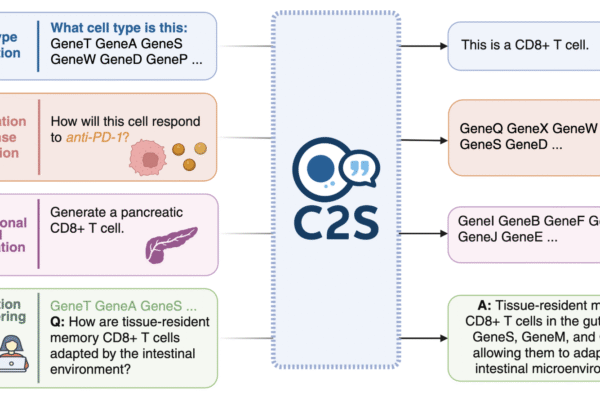
Google AI Releases C2S-Scale 27B Model that Translate Complex Single-Cell Gene Expression Data into ‘cell sentences’ that LLMs can Understand

A team of researchers from Google Research, Google DeepMind, and Yale released C2S-Scale 27B, a 27-billion-parameter foundation model for single-cell analysis built on Gemma-2. The model formalizes single-cell RNA-seq (scRNA-seq) profiles as “cell sentences”—ordered lists of gene symbols—so that a language model can natively parse and reason over cellular states. Beyond benchmarking gains, the research…

Read More

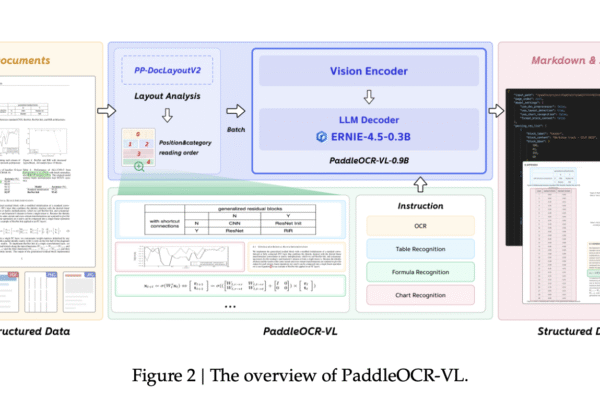
Baidu’s PaddlePaddle Team Releases PaddleOCR-VL (0.9B): a NaViT-style + ERNIE-4.5-0.3B VLM Targeting End-to-End Multilingual Document Parsing

How do you convert complex, multilingual documents—dense layouts, small scripts, formulas, charts, and handwriting—into faithful structured Markdown/JSON with state-of-the-art accuracy while keeping inference latency and memory low enough for real deployments?Baidu’s PaddlePaddle group has released PaddleOCR-VL, a 0.9B-parameter vision-language model designed for end-to-end document parsing across text, tables, formulas, charts, and handwriting. The core model…

Read More

Qualifire AI Releases Rogue: An End-to-End Agentic AI Testing Framework, Evaluating the Performance of AI Agents

Agentic systems are stochastic, context-dependent, and policy-bounded. Conventional QA—unit tests, static prompts, or scalar “LLM-as-a-judge” scores—fails to expose multi-turn vulnerabilities and provides weak audit trails. Developer teams need protocol-accurate conversations, explicit policy checks, and machine-readable evidence that can gate releases with confidence. Qualifire AI has open-sourced Rogue, a Python framework that evaluates AI agents over…

Read More

Qualifire AI Open-Sources Rogue: An End-to-End Agentic AI Testing Framework Designed to Evaluate the Performance, Compliance, and Reliability of AI Agents

Agentic systems are stochastic, context-dependent, and policy-bounded. Conventional QA—unit tests, static prompts, or scalar “LLM-as-a-judge” scores—fails to expose multi-turn vulnerabilities and provides weak audit trails. Developer teams need protocol-accurate conversations, explicit policy checks, and machine-readable evidence that can gate releases with confidence. Qualifire AI has open-sourced Rogue, a Python framework that evaluates AI agents over…

Read More