




How to Build a Fully Self-Verifying Data Operations AI Agent Using Local Hugging Face Models for Automated Planning, Execution, and Testing

In this tutorial, we build a self-verifying DataOps AIAgent that can plan, execute, and test data operations automatically using local Hugging Face models. We design the agent with three intelligent roles: a Planner that creates an execution strategy, an Executor that writes and runs code using pandas, and a Tester that validates the results for…

Read More

OpenAI Introduces GPT-5.1: Combining Adaptive Reasoning, Account Level Personalization, And Updated Safety Metrics In The GPT-5 Stack

OpenAI has released GPT-5.1 as the next iteration in the GPT-5 family, with 2 core variants, GPT-5.1 Instant and GPT-5.1 Thinking. The update focuses on 3 axes, adaptive reasoning behavior, clearer explanations, and stronger control over tone and safety. Model Lineup And Positioning GPT-5.1 Instant is the default conversational model in ChatGPT. OpenAI describes it…

Read More

How to Build a Fully Functional Custom GPT-style Conversational AI Locally Using Hugging Face Transformers

In this tutorial, we build our own custom GPT-style chat system from scratch using a local Hugging Face model. We start by loading a lightweight instruction-tuned model that understands conversational prompts, then wrap it inside a structured chat framework that includes a system role, user memory, and assistant responses. We define how the agent interprets…

Read More

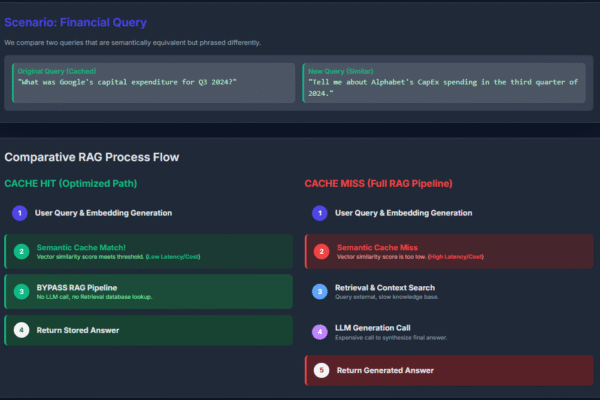
How to Reduce Cost and Latency of Your RAG Application Using Semantic LLM Caching

Semantic caching in LLM (Large Language Model) applications optimizes performance by storing and reusing responses based on semantic similarity rather than exact text matches. When a new query arrives, it’s converted into an embedding and compared with cached ones using similarity search. If a close match is found (above a similarity threshold), the cached response…

Read More

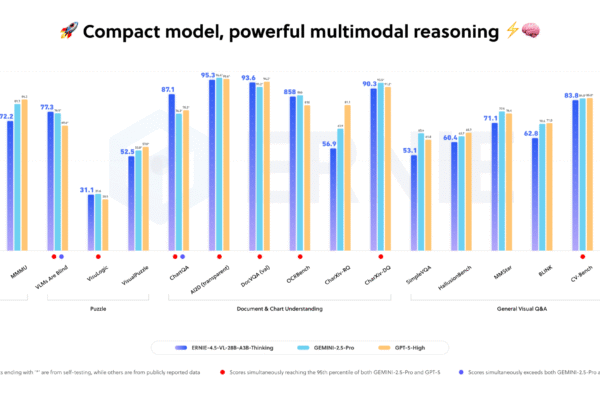
Baidu Releases ERNIE-4.5-VL-28B-A3B-Thinking: An Open-Source and Compact Multimodal Reasoning Model Under the ERNIE-4.5 Family

How can we get large model level multimodal reasoning for documents, charts and videos while running only a 3B class model in production? Baidu has added a new model to the ERNIE-4.5 open source family. ERNIE-4.5-VL-28B-A3B-Thinking is a vision language model that focuses on document, chart and video understanding with a small active parameter budget….

Read More

How to Build an End-to-End Interactive Analytics Dashboard Using PyGWalker Features for Insightful Data Exploration

def generate_advanced_dataset(): np.random.seed(42) start_date = datetime(2022, 1, 1) dates = [start_date + timedelta(days=x) for x in range(730)] categories = [‘Electronics’, ‘Clothing’, ‘Home & Garden’, ‘Sports’, ‘Books’] products = { ‘Electronics’: [‘Laptop’, ‘Smartphone’, ‘Headphones’, ‘Tablet’, ‘Smartwatch’], ‘Clothing’: [‘T-Shirt’, ‘Jeans’, ‘Dress’, ‘Jacket’, ‘Sneakers’], ‘Home & Garden’: [‘Furniture’, ‘Lamp’, ‘Rug’, ‘Plant’, ‘Cookware’], ‘Sports’: [‘Yoga Mat’, ‘Dumbbell’, ‘Running Shoes’,…

Read More

Meta AI Releases Omnilingual ASR: A Suite of Open-Source Multilingual Speech Recognition Models for 1600+ Languages

How do you build a single speech recognition system that can understand 1,000’s of languages including many that never had working ASR (automatic speech recognition) models before? Meta AI has released Omnilingual ASR, an open source speech recognition suite that scales to more than 1,600 languages and can be extended to unseen languages with only…

Read More

A Coding Implementation to Build and Train Advanced Architectures with Residual Connections, Self-Attention, and Adaptive Optimization Using JAX, Flax, and Optax

In this tutorial, we explore how to build and train an advanced neural network using JAX, Flax, and Optax in an efficient and modular way. We begin by designing a deep architecture that integrates residual connections and self-attention mechanisms for expressive feature learning. As we progress, we implement sophisticated optimization strategies with learning rate scheduling,…

Read More

Moonshot AI Releases Kosong: The LLM Abstraction Layer that Powers Kimi CLI

Modern agentic applications rarely talk to a single model or a single tool, so how do you keep that stack maintainable when providers, models and tools keep changing every few weeks. Moonshot AI’s Kosong targets this problem as an LLM abstraction layer for agent applications. Kosong unifies message structures, asynchronous tool orchestration and pluggable chat…

Read More