




Meet ‘kvcached’: A Machine Learning Library to Enable Virtualized, Elastic KV Cache for LLM Serving on Shared GPUs

Large language model serving often wastes GPU memory because engines pre-reserve large static KV cache regions per model, even when requests are bursty or idle. Meet ‘kvcached‘, a library to enable virtualized, elastic KV cache for LLM serving on shared GPUs. kvcached has been developed by a research from Berkeley’s Sky Computing Lab (University of…

Read More

5 Common LLM Parameters Explained with Examples

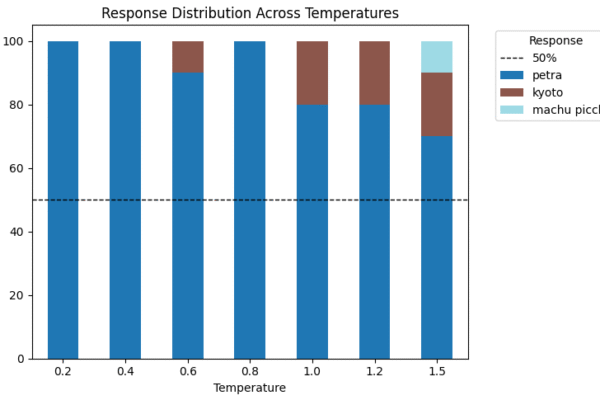
Large language models (LLMs) offer several parameters that let you fine-tune their behavior and control how they generate responses. If a model isn’t producing the desired output, the issue often lies in how these parameters are configured. In this tutorial, we’ll explore some of the most commonly used ones — max_completion_tokens, temperature, top_p, presence_penalty, and…

Read More

How to Build, Train, and Compare Multiple Reinforcement Learning Agents in a Custom Trading Environment Using Stable-Baselines3

In this tutorial, we explore advanced applications of Stable-Baselines3 in reinforcement learning. We design a fully functional, custom trading environment, integrate multiple algorithms such as PPO and A2C, and develop our own training callbacks for performance tracking. As we progress, we train, evaluate, and visualize agent performance to compare algorithmic efficiency, learning curves, and decision…

Read More

A New AI Research from Anthropic and Thinking Machines Lab Stress Tests Model Specs and Reveal Character Differences among Language Models

AI companies use model specifications to define target behaviors during training and evaluation. Do current specs state the intended behaviors with enough precision, and do frontier models exhibit distinct behavioral profiles under the same spec? A team of researchers from Anthropic, Thinking Machines Lab and Constellation present a systematic method that stress tests model specs…

Read More