



NVIDIA AI Introduces TiDAR: A Hybrid Diffusion Autoregressive Architecture For High Throughput LLM Inference

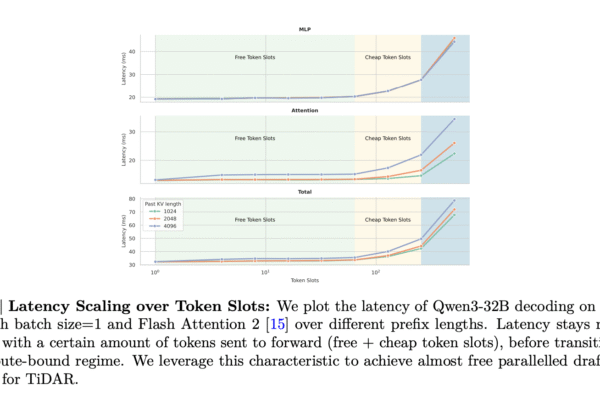
How far can we push large language model speed by reusing “free” GPU compute, without giving up autoregressive level output quality? NVIDIA researchers propose TiDAR, a sequence level hybrid language model that drafts tokens with diffusion and samples them autoregressively in a single forward pass. The main goal of this research is to reach autoregressive…

Read More

Meet SDialog: An Open-Source Python Toolkit for Building, Simulating, and Evaluating LLM-based Conversational Agents End-to-End

How can developers reliably generate, control, and inspect large volumes of realistic dialogue data without building a custom simulation stack every time? Meet SDialog, an open sourced Python toolkit for synthetic dialogue generation, evaluation, and interpretability that targets the full conversational pipeline from agent definition to analysis. It standardizes how a Dialog is represented and…

Read More

How Powerful are Diffusion LLMs? Rethinking Generation with Any-Process Masked Diffusion Models

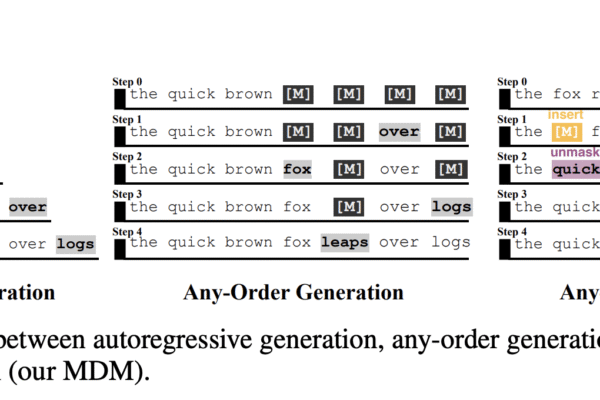
How powerful are Diffusion LLMs compared to classic autoregressive LLMs, once you treat generation as an algorithm with time and space complexity, not just as a decoding trick? A new research paper from a team researchers from Toyota Technological Institute at Chicago and MIT gives a formal answer. This new research compares Auto-Regressive Models (ARM),…

Read More

How to Build a Fully Self-Verifying Data Operations AI Agent Using Local Hugging Face Models for Automated Planning, Execution, and Testing

In this tutorial, we build a self-verifying DataOps AIAgent that can plan, execute, and test data operations automatically using local Hugging Face models. We design the agent with three intelligent roles: a Planner that creates an execution strategy, an Executor that writes and runs code using pandas, and a Tester that validates the results for…

Read More

OpenAI Introduces GPT-5.1: Combining Adaptive Reasoning, Account Level Personalization, And Updated Safety Metrics In The GPT-5 Stack

OpenAI has released GPT-5.1 as the next iteration in the GPT-5 family, with 2 core variants, GPT-5.1 Instant and GPT-5.1 Thinking. The update focuses on 3 axes, adaptive reasoning behavior, clearer explanations, and stronger control over tone and safety. Model Lineup And Positioning GPT-5.1 Instant is the default conversational model in ChatGPT. OpenAI describes it…

Read More

How to Build a Fully Functional Custom GPT-style Conversational AI Locally Using Hugging Face Transformers

In this tutorial, we build our own custom GPT-style chat system from scratch using a local Hugging Face model. We start by loading a lightweight instruction-tuned model that understands conversational prompts, then wrap it inside a structured chat framework that includes a system role, user memory, and assistant responses. We define how the agent interprets…

Read More

How to Reduce Cost and Latency of Your RAG Application Using Semantic LLM Caching

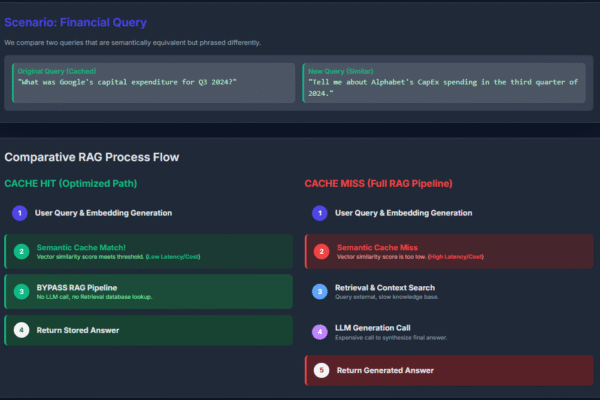
Semantic caching in LLM (Large Language Model) applications optimizes performance by storing and reusing responses based on semantic similarity rather than exact text matches. When a new query arrives, it’s converted into an embedding and compared with cached ones using similarity search. If a close match is found (above a similarity threshold), the cached response…

Read More

Baidu Releases ERNIE-4.5-VL-28B-A3B-Thinking: An Open-Source and Compact Multimodal Reasoning Model Under the ERNIE-4.5 Family

How can we get large model level multimodal reasoning for documents, charts and videos while running only a 3B class model in production? Baidu has added a new model to the ERNIE-4.5 open source family. ERNIE-4.5-VL-28B-A3B-Thinking is a vision language model that focuses on document, chart and video understanding with a small active parameter budget….

Read More

How to Build an End-to-End Interactive Analytics Dashboard Using PyGWalker Features for Insightful Data Exploration

def generate_advanced_dataset(): np.random.seed(42) start_date = datetime(2022, 1, 1) dates = [start_date + timedelta(days=x) for x in range(730)] categories = [‘Electronics’, ‘Clothing’, ‘Home & Garden’, ‘Sports’, ‘Books’] products = { ‘Electronics’: [‘Laptop’, ‘Smartphone’, ‘Headphones’, ‘Tablet’, ‘Smartwatch’], ‘Clothing’: [‘T-Shirt’, ‘Jeans’, ‘Dress’, ‘Jacket’, ‘Sneakers’], ‘Home & Garden’: [‘Furniture’, ‘Lamp’, ‘Rug’, ‘Plant’, ‘Cookware’], ‘Sports’: [‘Yoga Mat’, ‘Dumbbell’, ‘Running Shoes’,…

Read More